You’re ready to spend real money—what are you actually buying with Mirror vs. Tempo?
You’re not just buying a screen. You’re buying a workout setup that will take over a corner of your home and shape what you actually do when you’re tired, busy, or short on time.
Mirror is mainly a wall-mounted (or leaning) class display that works best when you want coached sessions with minimal gear and a room that can stay mostly open. Tempo Studio is a freestanding strength station built around lifting and form feedback, and it assumes you’re okay living with visible equipment and a dedicated footprint.
The hard part is that the “better” choice depends less on specs and more on where it will live and what next week’s workouts need to feel like.
Where will it live day to day (and will you resent it there)?
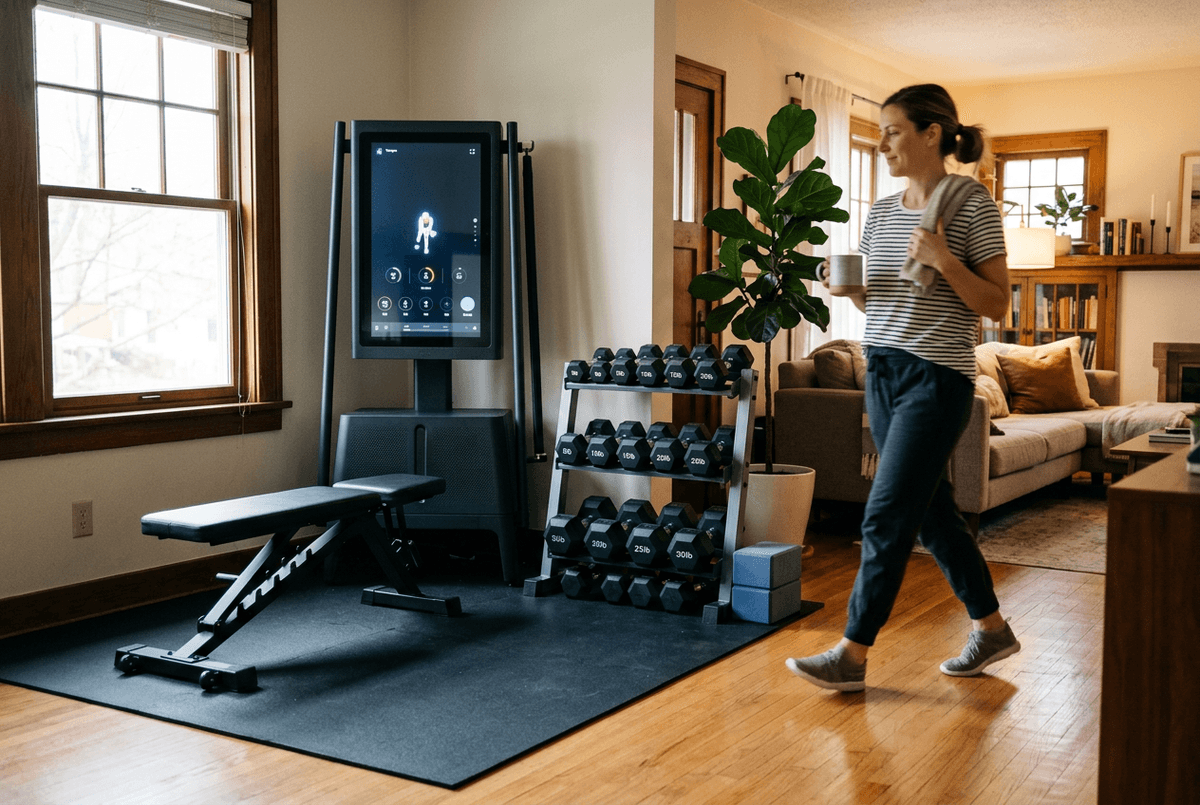
That “where it will live” question usually shows up the first time you try to picture a normal morning: you’re carrying laundry through the room, a chair is half in the workout zone, and you realize the setup can’t just exist during workouts—it has to coexist the other 23 hours.
Mirror asks for clean wall space and enough open floor to step back and move. If it’s in a bedroom, a hallway edge, or an office, it can feel like it disappears until you start a class. The catch is glare and sightlines: if the only spot faces a bright window or sits behind a door swing, you’ll notice it every day. Tempo Studio makes the opposite demand. It wants a stable, permanent spot where you won’t mind walking past a strength station and its weights.
If you’ll resent seeing gear out—or constantly shuffling furniture—pick the option that needs fewer daily “resets.”
When you imagine next Tuesday’s workout, what do you want it to look like?
That daily “reset” problem usually shows up right before you hit Play: you have 35 minutes, your brain wants the simplest path, and anything that feels like setup becomes a quiet excuse to skip. If you want next Tuesday to be a low-friction class—warm-up, follow the coach, finish sweaty—Mirror fits that mental model. You clear a rectangle of floor, grab light weights (or none), and the workout is mostly about keeping pace.
If, instead, you want next Tuesday to look like a strength session with numbers—sets, reps, rest, and a plan you can repeat—Tempo Studio is built for that rhythm. You’re more likely to do squats, presses, and rows with heavier dumbbells, and you’ll notice whether your form is close enough to what the program expects.
The real constraint is time and tolerance for fiddling. Tempo sessions can take longer once you factor in weight changes and re-racking. Mirror can feel too “general” if you’re chasing measurable strength progress. Picture the version of tired-you that still works out, and choose for that person.
The equipment question: how much stuff are you willing to own—and store?
That “tired-you” test gets real when you have to touch the gear. If you want to work out in whatever room is available, Mirror stays flexible because it can be almost gear-free. A mat, maybe a couple of light dumbbells, and you’re done. The moment you start adding bands, heavier weights, sliders, and a bench, Mirror stops being “just a screen” and becomes a small fitness closet you have to manage.
Tempo Studio flips that: the point is the equipment. You’re committing to dumbbells and plates as part of the experience, plus the habit of putting them back where they belong. That can feel clean if you like a set place for everything, but it’s annoying if your workout space is also a living space you want to reset fast.
Be honest about storage. If you don’t already have a home for weights, you’ll create one—on the floor, in a corner, or in your head as one more chore.
Who needs the screen: just you, or a whole household with different goals?
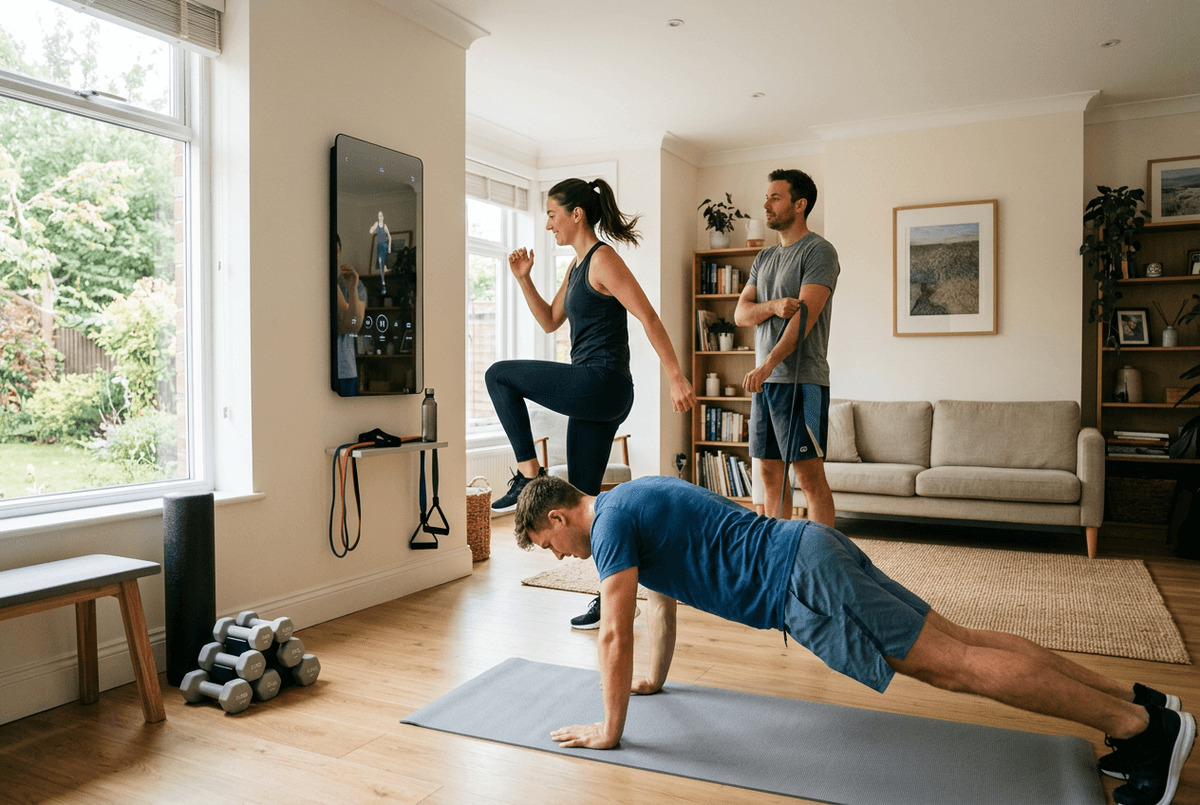
That “one more chore” feeling gets louder when more than one person is trying to use the setup. In a shared home, the winner is usually the product that matches the most people’s default workout, not the one that’s best on paper for one person. If your household is mostly “I want a class and I’m done,” Mirror’s flexible, low-setup format makes it easier for different schedules and fitness levels to rotate in without negotiating equipment.
Tempo Studio works best when at least one or two people actually want strength training with progression. If one person loves lifting but everyone else just wants a quick sweat, the station can turn into someone else’s project taking up shared space. It also adds small conflicts: changing weights mid-session, needing the same floor area, and re-racking so the next person isn’t starting with a mess.
Look at your calendar. If two people will realistically use it three days a week, pick the setup that makes that easy, not aspirational.
Membership and ownership reality check—what will this cost you after the honeymoon phase?
That calendar test gets more honest once you add the monthly bill. Most people love the first few weeks because everything is new and guided, then reality hits: you’re paying every month whether you use it twice a week or twice a month. With both Mirror and Tempo, the hardware is only part of the purchase. The library, coaching, tracking, and most of what makes it feel “premium” typically sits behind a membership, so canceling can turn a smart gym into a much dumber screen and some gear.
Then there are the quiet costs. Tempo ownership can grow if you keep “just adding” heavier weights or storage, and if you move homes, relocating a heavy station is harder than moving a wall-mounted screen. Mirror can stay lean, but only if you don’t end up buying the same accessories you were trying to avoid in the first place.
Before you pick, do one simple math check: what will you pay over 12 months if you use it at your realistic rate—and will that still feel worth it in week 12?
Your simplest ‘yes’ test: which one will still get used in week 12?
That week-12 question is really about what happens on the nights you’re tired and the room is messy: do you still hit Play, or do you step around the setup and keep walking?
If your easiest “yes” is a 20–40 minute coached class with almost no decisions, Mirror tends to survive week 12 because it asks less of you in the moment. If your easiest “yes” is “I want to get stronger and I like a plan,” Tempo Studio tends to survive week 12 because it gives you clear progression and enough structure to keep you honest.
Mirror can drift into background noise if you stop craving classes, while Tempo can stall if changing weights and re-racking starts to feel like chores. Pick the one you’d still use when motivation is low and time is tight.